Harrogate Town Council
Britain's Spa Town
Harrogate Town Council is a new body for Britain’s Spa Town. Rooted in Harrogate’s springs, landscape and tradition of public stewardship, the identity emerges as system for council and town, grounded in civic heritage and aspiring to the future.
At a time when local identity, public trust and civic representation are increasingly important, Harrogate Town Council marks a new chapter for the town. Its formation returns decision-making closer to the community, creating a renewed structure for care, visibility and public custodianship.
The new identity needed to reflect the authority of the new Council, while also giving Harrogate a wider place symbol that could speak to landscape, culture and community life.

Harrogate is borne of water. Its spirit lies in a convergence of superlative nature, hospitality and wellbeing. The mineral springs beneath the town gave rise to a healing culture - a spa tradition that placed the town on an international stage. But it was not just the waters that defined Harrogate. It was the collective will to protect them.
The Stray - 200 acres of open grassland at the heart of the town - exists because of that will. Secured by public petition in 1778, it was formalised to ensure the springs remained accessible to all. That spirit of stewardship runs deep. From the ancient Royal Forest of Knaresborough to the common spaces of the town, Harrogate’s landscape has long been shaped by care.
What emerged over time is a layered civic character: genteel yet open, historic yet adaptable. A town that looks outward, but is rooted in the distinctiveness of its geography, its ecology and its rhythm of public life. It is this character - already present, already expressed in fragments - that the emergent identity seeks to surface, clarify and carry forward.


In 2025, Harrogate Town Council was established - a moment of civic renewal that reintroduced a local voice after decades of absence. Its formation was not simply an administrative development, but the reawakening of a structure through which care, representation and public custodianship could be more directly exercised.
It posed a question: how might this renewed voice be made legible? How could this place give form to something that is both unifying and symbolic - a body acting on behalf of a place, yet not above it?
The answer was found in recognising relationships. Harrogate did not need a new image; it needed clarity. It needed to make visible the living relationship between place and institution, between what is held and who holds it.


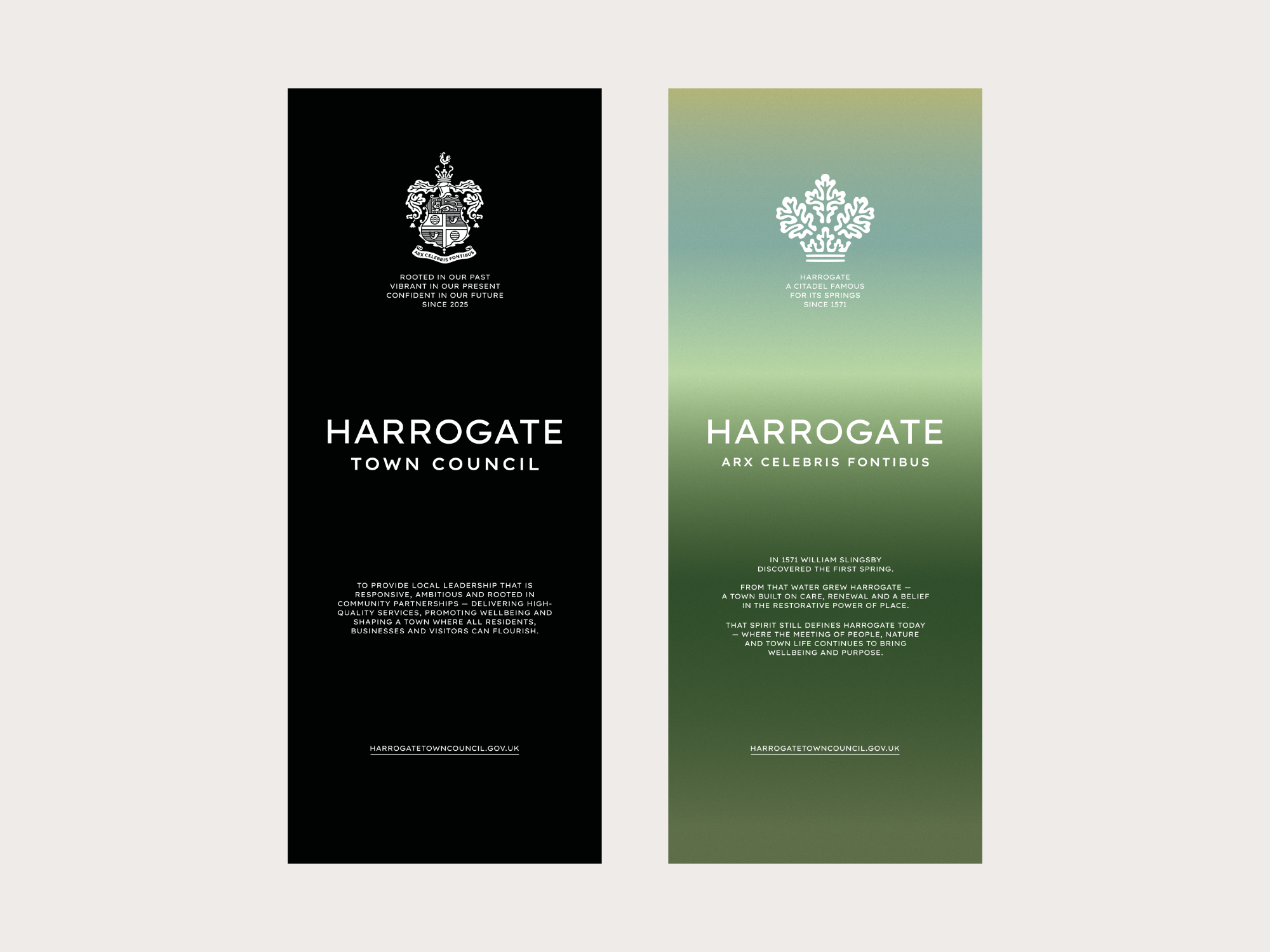
The starting point was Harrogate’s 1884 coat of arms, long etched into the town’s architecture and consciousness. This heraldic achievement was redrawn with precision, restoring its symbolism and dignity for contemporary use.
From that foundation, a second mark emerged - the Crown of Springs, distilled from the coronet of the Arms and reimagined as three rising oak leaves. One embodies continuity; the other renewal.
Together, they create a visual equilibrium between permanence and progression - a dual system that speaks with one voice across council, community and place.